
A Tribe Called Love sets the stage for more Somali-Canadian stories
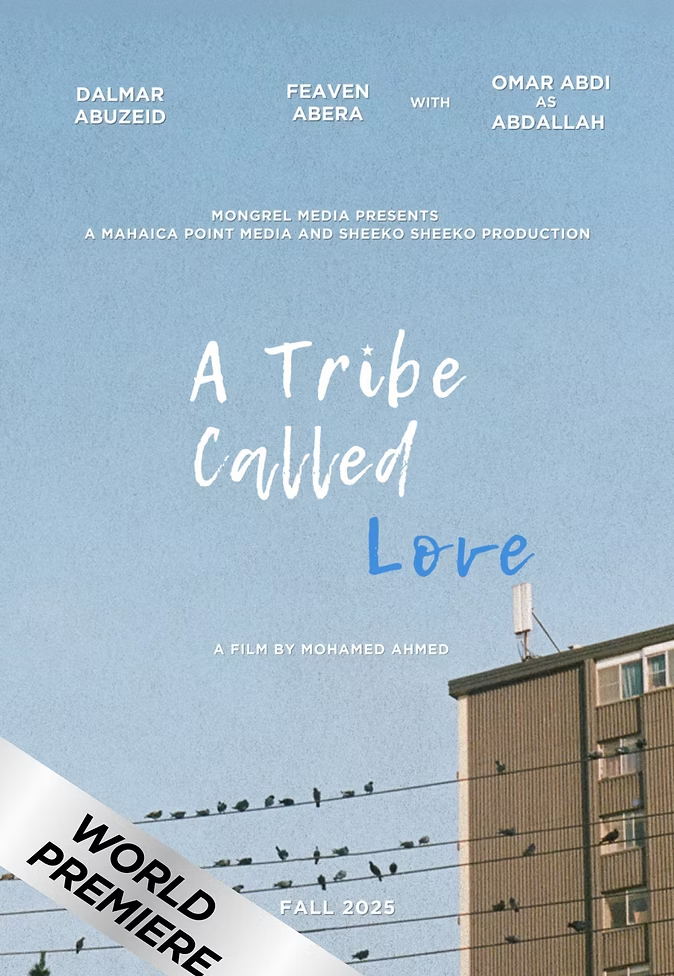
Mohamed Ahmed’s A Tribe Called Love is a heartwarming and heartbreaking Romeo & Juliet story for the Somali diaspora.
Although not flawless, the directorial debut from Ahmed is full of nostalgia, strong shot work, and a transparent look at how tribalism affects modern communities far from home.
Set amongst the Somali community in Toronto, the film follows Farah both as a child (played by Ahmed Ibrahim) and adult (played by Dalmar Abuzeid) as he tries to pursue a romantic relationship with in with Halima (played by Older Feaven Abera), a fellow Somali but from a different tribe than his own.
The film is made with a non-Somali audience in mind and takes the time to explain parts of the Somali tribal hierarchy, cultural dynamics, and values. Farah is of the Midgaan tribe, infamously looked down upon by other Somali tribes as being ‘dirty’ and generally less than. The myth that precedes the dominant view of this tribe amongst other Somalis is that one of the ancestors of the tribe is starving in the desert and eats a dead animal to stay alive, but when word gets back to the community of other tribes he and his bloodline are shunned for the rest of time.
The film avoids a trope many intergenerational immigrant community films tend to use by showing young Farah that almost everyone in his life, including his friend group, holds some version of this hierarchy in mind, rather than painting the dilemma as a forward-thinking-versus-backward-thinking dispute between the generations.
The first half of the film focuses on the young actors and budding crush, and utilizes charming animation and special effects to do so. Although sometimes underwhelming in quality, these more colourful bits in the film are definitely appreciated in keeping a youthful charm, enriching the nostalgic feeling of the film. Ahmed takes inspiration from the likes of Edgar Wright’s Scott Pilgrim vs The World bolstering fun animation effects and a deep care for the stage of Toronto. The young actors, many of whom were making their screen debut, showed considerable potential. The majority of the child actors do a good job with facial reactions, but their emotional delivery wasn’t all there in most scenes. Muntaha Mohamed delivers a highlight performance as young Halima with a strong charismatic presence. Ahmed Ibrahim scenes as young Farah are best when paired with Omar Abdi playing Farah’s father Abdalla. Although the two share little screen time as father and son, their dynamic is shown clearly and honestly.
The first half of the film portrays a very sweet picture of the Somali diaspora, and feels like a clear slice of life community film, so much so I was fully caught off guard by the mid-film twist. The film showcases the young adults organizing parts of the Somali community as a diverse collective, with a representative from each of the 4 major tribes. Their introduction scene is the four of them all having a good time on a basketball court, as Farah explains that their connection despite their tribal differences is a reason that tribal conflicts shouldn’t get in the way of relationships. Unfortunately it is quickly revealed that their collective is predominantly gang-organizing and drug trafficking, with tribal tensions still playing a role in how things are run. In fact, Farah’s pursuit of Halima is seen as a slight against a different tribe, which triggers the fatal public shooting of the Midgaan representative at a community celebration.
It’s easy to forget in the first half that the Romeo & Juliet story is more about the tragedy of romance than romance itself, but the drama surrounding the tragedy in A Tribe Called Love plays on the same tragedy of how the views of tribal hierarchy hurts the community at large, stopping both love and peace from truly taking root. Rather than sitting with the twist and the reaction to it, the film jumps 14 years into the future to Farah as an adult.
The introduction of the tribal conflict in relation to gang violence within the Somali community is a bit rushed, which although reasonable from Farah’s perspective as a child leaves a lot more questions about the community dynamics. The gang receives praise from Farah’s father for bringing inspiration and community values to the young people in the community, but the unspoken revelation then becomes that they are recruiting those young people into more gang-related activity. How are these young people being recruited? How is the gang structured as a result of the tribal makeup? What is the power structure of the leaders? How are the gang activities able to evade arrests or police involvement? Though in the Shakespearan classic much of the background tension behind the Capulets and Montageaus remains unexplained, given the film’s focus on the real-life Somali community, the lack of detailed insight into the gang violence before the time jump does pose a risk of portraying a diaspora that doesn’t frequently get media coverage of this scale in a poor light.
Following the time skip, the plot shows Farah clearly moved on from the mid-film events as his family relocated to Vancouver following the shooting. He is now working on a successful startup focused on stopping food waste with his new (white) best friend, Chris (Bruce Novakowski), and lives with his father still. The startup and friendship with Chris seem like they’ll get more screentime or discussion, but they mostly exist to reflect the direction Farah has taken his life.
When he is tasked with returning to Toronto to sell his family’s sambuusa restaurant, the film gives a quick and interesting glimpse into the lives of his friends and how they’ve changed. The casting of the grown-up versions of his friends was a bit hard to adjust to. Although the performances of the adult actors are pretty consistent, the plot doesn’t give as much explanation to some of their emotions or dynamics. There were only a few unique traits given to the younger actors, so outside of the improved sambuusa connoisseur, it took a while to figure out who was who.
Upon seeing grown-up Halima, Farah tries to make things better with the friends he kind of disappeared on by embarking on a campaign to revamp the restaurant and keep it open.
The romantic dynamic between adult Halima and Farah is one of the weaker points of the film. As the adaptation’s Juliet and Romeo, their connection upon re-meeting is definitely not love at first sight, but also isn’t given much room to blossom, instead relying on a couple montages for a date and then building the restaurant back up together. In the first half of the film Halima does at times feel like a ‘manic pixie dream girl,’ and it makes a lot of sense for a young boy to view his crush in that way, but as an adult, with not much more character given to their relationship, it doesn’t feel as ‘star-crossed lovers’ as I would have hoped.
What the film does succeed in, though, is showing how pervasive the harms of tribalism are amongst the diaspora. From Halima’s father shunning her for choosing to be with a man in a “lesser” tribe to gang violence focused on tribal superiority, the emphasis of how tribalism motivates conflict in the film is very clear. Mohammed Ahmed’s direction delivers this message in a well-constructed world that brings an often overlooked Toronto community to the screen.


